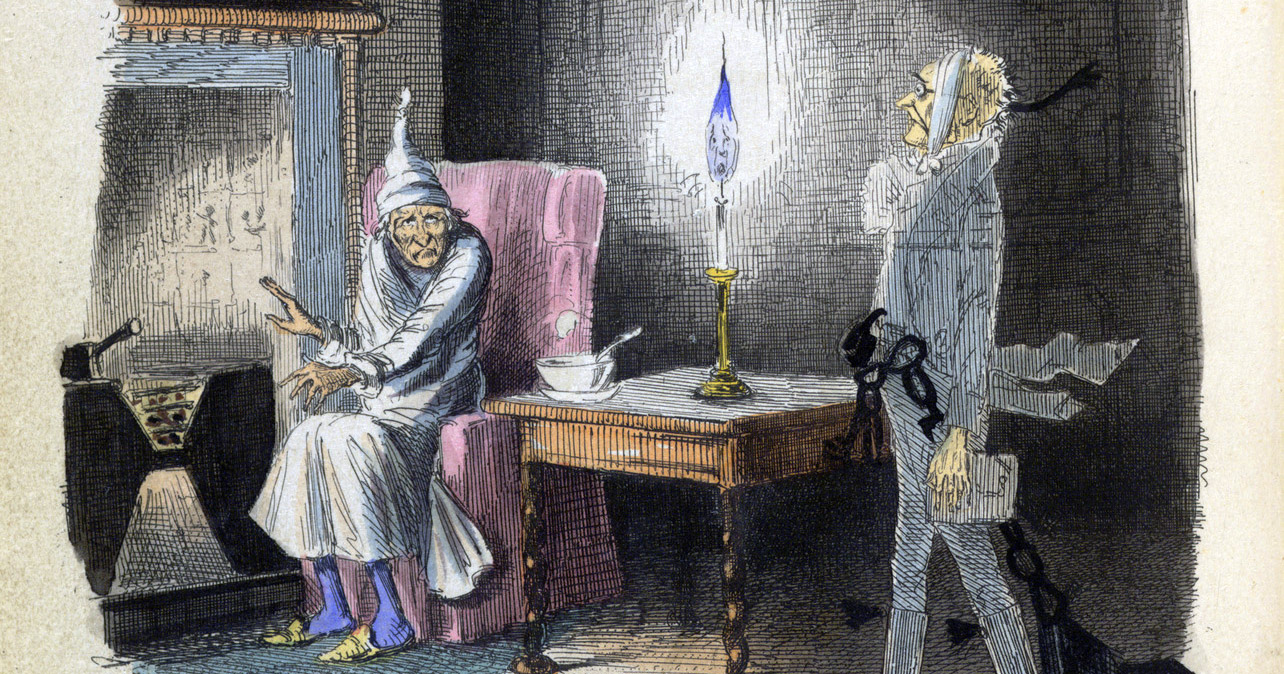
This post is part of an occasional series about ethnography and folklore in Dickens’s A Christmas Carol. Find the whole series here! In our last look at the foodways of Dickens’s classic story A Christmas Carol, we examined the joy the Cratchits take in their small but serviceable Christmas goose, as Scrooge and the Ghost …
Charles Dickens's A Christmas Carol reveals an interesting fact about Victorian London: many working class people lacked cooking facilities, with only a hearth fire in their homes. In this post, we'll see some of their strategies for cooking a meal by looking at the Cratchits, the only working class family depicted in the book in a detailed way. We'll also look beyond the Cratchits to other London families in the same boat, and show how Dickens expresses social and political ideas about foodways through Scrooge and his interactions.
In this post, we read segments of Charles Dickens's A Christmas Carol ethnographically, exploring the aspects of cultural context that stand out as different, surprising, and in need of explanation. In particular, this year we'll examine unusual aspects of Dickensian foodways. In this first post, we'll find out how to determine what Scrooge ate on Christmas Eve, and discuss supernatural belief and folk medicine along the way.
La Llorona, the Weeping Woman, is a spirit that haunts the folklore of Mexico and other Latin American countries. In some versions she's a ghost, but in others she's an immortal wanderer, not dead but not really alive either. So far in the series, we've introduced the legend, given some of its history, explored songs related to La Llorona, and discussed the story's role in growing up. Now, we present a telling of the tale. The post contains audio and a transcript of a performance by Joe Hayes, one of the best known storytellers from the American southwest. Hayes's bilingual Spanish-English storytelling has earned him a distinctive place among America’s professional storytellers.
Halloween and Día de Muertos are almost here! So, believe it or not, Season 4, Episode 1 of the Folklife Today Podcast, our 2021 Halloween and Día de Muertos episode, is ready for listening! It features interviews about the Weeping Woman, La Llorona, a spirit from Latin American folklore, plus related songs and stories. The people interviewed are Juan Díes, leader of the Sones de Mexico Ensemble, Camille Acosta, who wrote her masters thesis on La Llorona before interning at AFC, and Allina Migoni, AFC's Latinx subject specialist. This blog contains links to download the podcast, background on our guests, and links to full audio of the songs.
This is the fourth blog post in a series about La Llorona, the Weeping Woman, a spirit that haunts the folklore of Mexico and other Latin American countries. We'll present comments on the legend by the writer Rudolfo Anaya, the scholar Domino Renee Perez, our former intern and Llorona expert Camille Acosta, pioneering Costa Rican writer Manuel Argüello Mora, and Esperanza Sernas, a restaurant worker interviewed in 1977 by fieldworker Philip George for AFC's Chicago Ethnic Arts Project. This blog also contains one of the most gruesome traditional descriptions of La Llorona we've seen so far! The whole series will be published in time for Día de Muertos (aka Día de los Muertos) 2021, so stay tuned....
This is the third blog post in a series about La Llorona, the weeping woman who haunts Mexican and other Latinx cultures. The series will be published in time for Día de Muertos (aka Día de los Muertos) 2021. In this post we talk about songs associated with the La Llorona legend. I spend the most time with the traditional song from Oaxaca, which was featured recently at the GRAMMY Awards and in the movie Coco. I also discuss a widespread (and completely different) folksong called "La Llorona" in the son huasteco repertoire, and "La Llorona Loca," a song composed in Colombia that has become a mainstay in Mexican music as well. What all La Llorona songs have in common are the themes of death, remembrance, and mourning, which makes them all appropriate for Día de Muertos or Halloween. We hope this post will be useful in building your own personal playlist for these upcoming holidays.
This is the second blog post in a series about La Llorona, the weeping woman who haunts Mexican and other Latinx cultures. The series will be published in time for Día de Muertos 2021. In this post, I'll show some of the story's long history, especially in Mexico. I'll give links to primary sources from the 1570s showing the story was already present among Indigenous Mexicans at that time and earlier. I'll also present what I believe is new evidence of a strong link for some La Llorona stories with Spain.
In Latin America, in Spanish-speaking communities in the U.S., and especially in Mexico, no ghost story is told as often, discussed as enthusiastically, or interpreted as widely, as the legend of La Llorona. With this introduction, AFC kicks off a short series of blogs on La Llorona stories and songs between now and Día de Muertos